

Starting Stage 1: Building an AI Editorial Co-Pilot for ABN AMRO Insights
Over the past period, I have started working on an AI project for ABN AMRO that sits at the intersection of content strategy, retrieval-augmented generation, and responsible AI adoption in a banking environment.
The project is currently called AURORA, although the name is still a working title. The core idea is simple: build an AI-powered editorial co-pilot that helps domain experts write and review articles for the ABN AMRO Insights channel.
Many articles on Insights are written by experts in banking, technology, markets, or sector analysis. These people have strong subject-matter knowledge, but they are not always professional content writers. That creates a familiar challenge: the knowledge is valuable, but the final article still needs to match ABN AMRO’s tone of voice, editorial guidelines, structure, and quality expectations.
Our goal is not to replace editors or automate publishing decisions. Instead, the co-pilot should support the writing and review process, with humans staying in control.
What problem are we trying to solve?
The business problem is very practical.
Experts create content, but drafts can vary in tone, structure, and clarity. Reviewers then need to spend time checking whether the article fits the publication standard. At the same time, older articles may need to be refreshed, and the organization is also moving toward a new CRM environment where automated quality checks could become very valuable.
So the project is not only about generating text. It is about creating a reliable support system for editorial work.
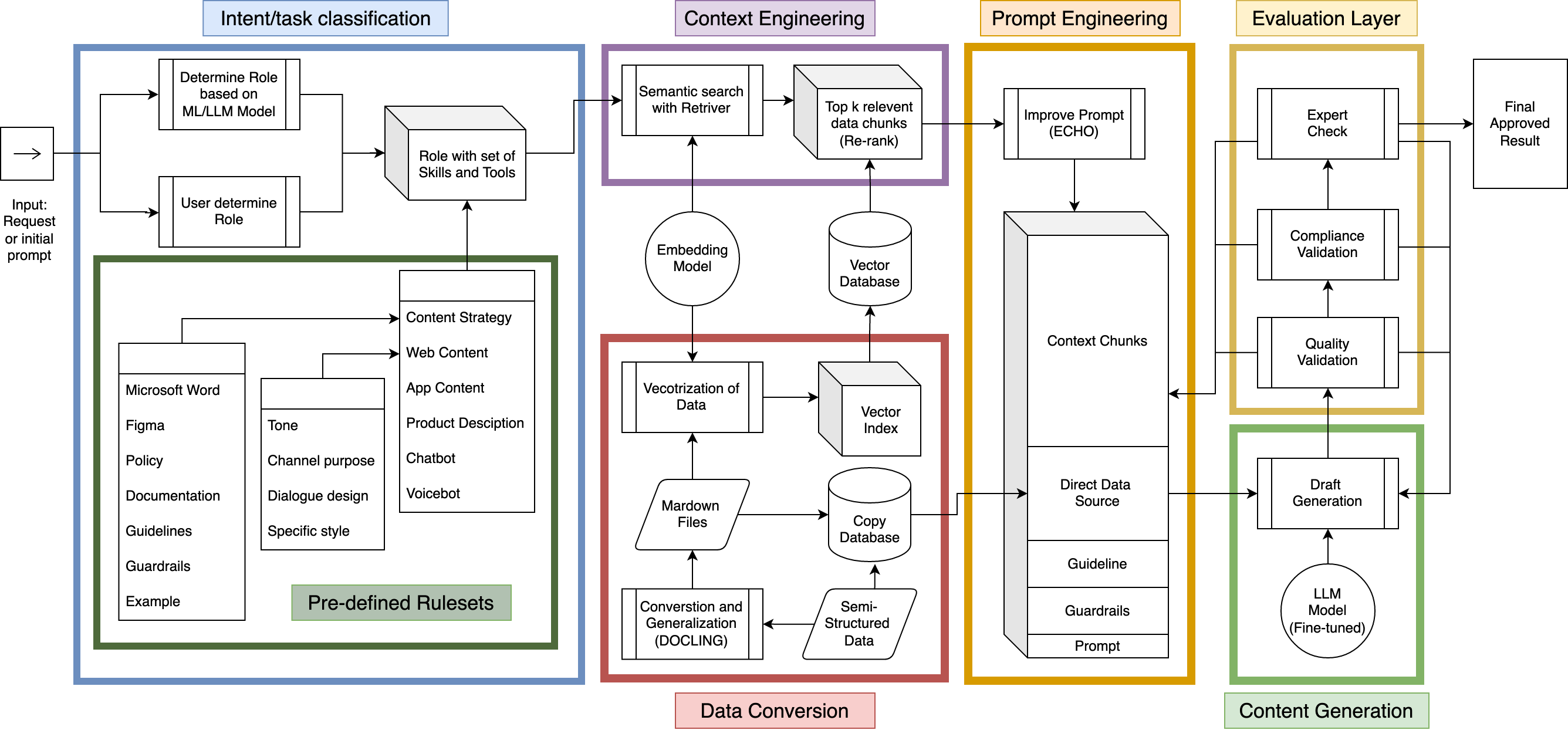
The co-pilot should eventually help with five main tasks:
- Helping experts create content aligned with ABN AMRO’s criteria.
- Checking articles before they enter the new CRM database.
- Turning those checks into a reusable automated pipeline or agent skill.
- Identifying and supporting the renewal of articles older than one year.
- Providing a strong business analysis so ABN AMRO can make an informed architecture decision.
The fifth point is especially important. This project is not just a proof of concept. It is also meant to help the organization decide what kind of retrieval architecture would be realistic, maintainable, secure, and scalable in the long term.
Why retrieval matters
A key challenge in this project is grounding the AI system in the right source material.
The co-pilot should not simply generate generic marketing text. It needs to understand ABN AMRO’s writing guide, approved examples, channel-specific expectations, and guardrails. That means retrieval is one of the most important design decisions in the whole project.
At this stage, we are comparing two different retrieval approaches.
The first is a more traditional vector-based RAG approach. In this setup, documents are split into chunks, embedded into vectors, stored in a vector database, and retrieved based on semantic similarity. This is a well-known architecture and can scale well when the document base becomes large.
The second is a vectorless PageIndex tree-based approach. Instead of embedding all content into a vector database, documents are converted into a hierarchical structure with summaries at different levels. Retrieval then works through document descriptions, section summaries, and text overlap. This approach may be more explainable and easier to audit, which matters a lot in a regulated banking context.
The interesting part is that we are not choosing based on assumptions. We are implementing both tracks so that the final recommendation can be based on measurement and comparison.
What I have worked on so far
At the start of Stage 1, my focus has been on turning the broad project idea into something concrete and testable.
So far, the work has included understanding the business problem, mapping the role of the co-pilot, reviewing the project scope, and helping shape the first retrieval experiments. The current proof of concept is intentionally minimal. It does not need a polished user interface yet. The goal is to first prove whether the retrieval and review logic can work.
One important part of the current progress is the PageIndex POC. This track explores whether we can retrieve useful and explainable context without relying on embeddings or a vector database. The current setup can select relevant documents and retrieve sections from them using a tree-based structure. This is especially useful for normative documents such as a writing guide, where hierarchy and explainability matter.
The project currently uses a small corpus, including approved articles in Dutch and English, as well as the ABN AMRO Writing Guide. Keeping the corpus small at this stage is intentional. It allows us to test retrieval quality and prompt design without getting blocked by infrastructure complexity too early.
Another important part of the work is defining how we will compare the two retrieval tracks. The comparison will look at cost, technical complexity, maintenance, security, retrieval quality, scalability, explainability, vendor lock-in, and data freshness. For ABN AMRO, some of these dimensions are especially important, such as security, data residency, auditability, and vendor dependency.
What I learned in this first stage
One thing that became clear very quickly is that building an AI co-pilot is not only a technical challenge.
It is easy to focus on models, embeddings, prompts, and indexes. But in a business context, the harder questions are often about trust and adoption.
Can editors understand why the system retrieved a certain piece of context? Can the organization maintain the architecture after the POC? Can the system support human review instead of creating a black-box decision process? Can the solution work within the security expectations of a bank?
These questions shape the architecture as much as the technical design does.
Another learning is that “better AI” does not always mean “more complex AI.” A vector database may be powerful, especially for a large and growing article corpus. But for smaller, authoritative, structured documents like a writing guide, a tree-based retrieval approach may be easier to explain and maintain. The final solution may even become a hybrid: PageIndex for normative documents and vector search for a larger collection of approved examples.
Where the project is heading next
The next step is to continue Stage 1 by testing both retrieval tracks more deeply.
For the vector-based track, the focus will be on chunking strategy, embedding models, similarity metrics, and index design. For the PageIndex track, the focus will be on improving document selection, section retrieval, and explainability.
After that, the team will compare both approaches using the architecture matrix. The goal is to decide whether ABN AMRO should move forward with vector RAG, PageIndex, or a hybrid architecture.
In later stages, the co-pilot could be wrapped in a simple interface for content strategy users. It could also include an audit trail showing the original prompt, selected documents, retrieved sections, final context pack, model output, and reviewer decision. That auditability would be valuable, especially in a regulated environment.
Final reflection
For me, this project is exciting because it is not just about building an AI demo. It is about exploring what a responsible and useful AI workflow could look like inside a real organization.
The most valuable outcome will not only be a working proof of concept. It will also be a clear recommendation on what kind of architecture makes sense for ABN AMRO: technically, financially, operationally, and from a governance perspective.
Stage 1 is still the beginning, but the direction is becoming clear. We are building a co-pilot that supports experts, helps editors, and gives the organization a practical foundation for deciding how AI should fit into its content workflow.