

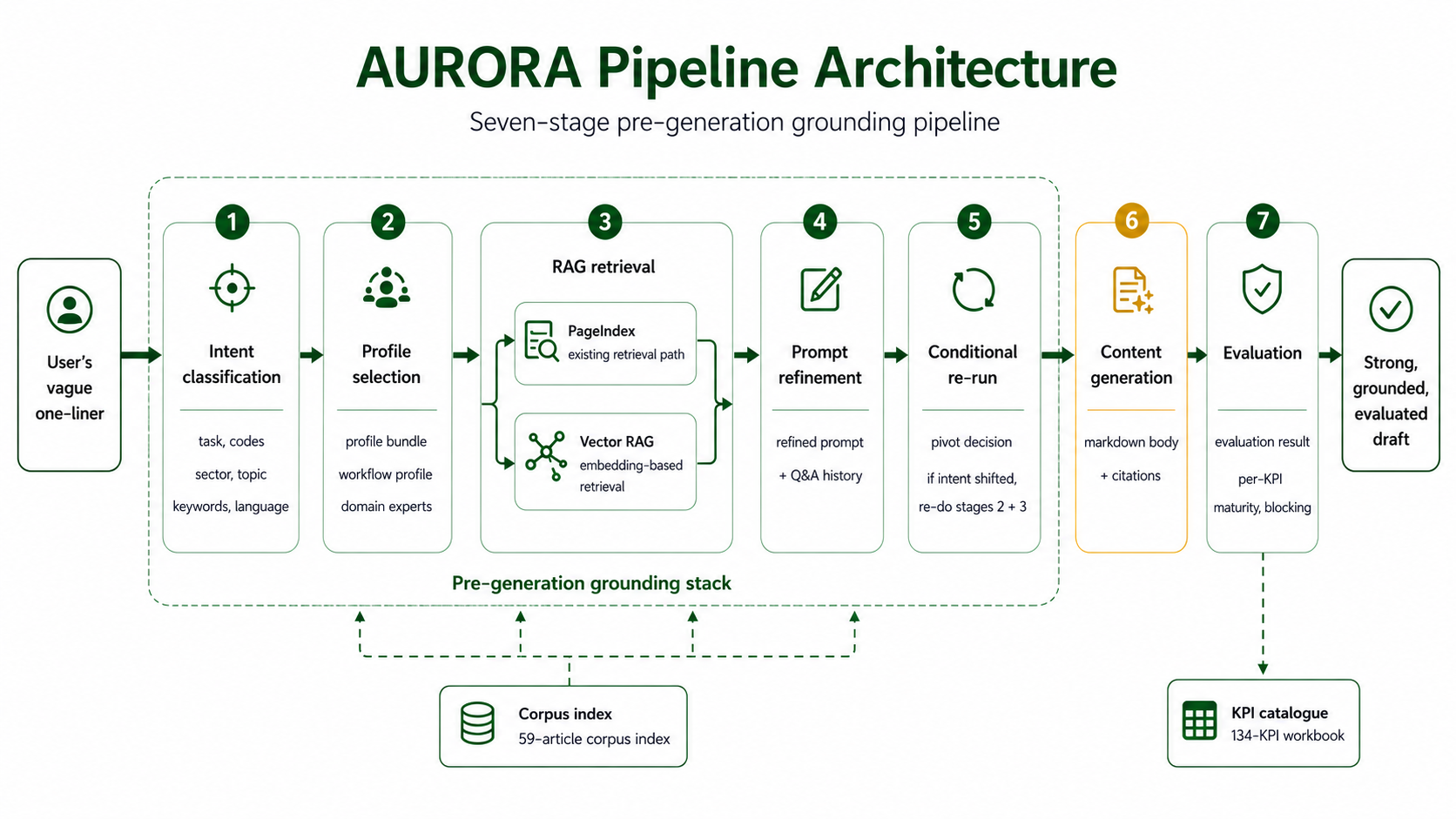
Over the past few weeks, I have been working on AURORA, an AI proof of concept developed in collaboration with ABN AMRO and AISO. The original goal was broad: explore how an autonomous agent could outperform a regular chatbot on content-writing tasks while staying compliant with company standards.
At the beginning, the obvious assumption was that more autonomy would make the system better. But through analysis, we found that the real weakness of a chatbot is upstream: users often give vague, one-line requests, and the model has to guess the brand voice, relevant context, allowed sources, and writing standards. If we add autonomy on top of that weak input, the system does not become more reliable. It just makes more confident guesses.
That insight shaped the core direction of AURORA: the value of the agentic workflow should happen before generation. Instead of asking the model to write immediately, the system first turns a vague request into a prompt that is specific, on-brand, and grounded in approved source material.
By the mid-cycle point, we had built and connected a seven-stage pipeline:
- Intent classification to structure the user’s raw request.
- Profile selection to apply the right workflow and domain expertise.
- Vector-based retrieval to find relevant published content.
- PageIndex retrieval to navigate source material in a more structured way.
- Prompt refinement to clarify the task using retrieved evidence.
- Content generation from the strengthened prompt.
- Evaluation against a multi-level KPI framework.
A key design decision was to split compliance into two parts. Instead of relying only on a final review after generation, AURORA constrains the input side by using approved sources, editorial profiles, and inspectable intermediate artifacts. Then, after generation, the output is evaluated separately against content-quality and compliance metrics. This makes the system easier to inspect, debug, and trust.
Another important decision was to place prompt refinement after retrieval, not before it. Rather than asking the user generic clarification questions, the system first retrieves real source material and then asks more useful questions based on what is actually available. This turns refinement into a discovery process instead of an interrogation.
My main achievement in this phase was helping move the project from an abstract idea about autonomy into a concrete, working architecture. AURORA now has a clear logic: classify the task, select the right editorial context, retrieve approved material, refine the prompt, generate the draft, and evaluate the result.Every stage produces an artifact that can be inspected, which means the system does not just produce an answer, it can explain how it got there.