

From Hackathon Idea to Working PoC: Automating Lead Discovery for UPS with AI
Last week, I had the opportunity to participate in the AI & Data Science Hackathon hosted by Soapbox, where our team worked on a real business challenge from United Parcel Service (UPS). The experience didn’t stop at the hackathon itself, it sparked a deeper exploration that led me to build a working Proof of Concept (PoC) demonstrating how AI-driven automation could significantly improve UPS’s customer acquisition process.
The Challenge: Manual Lead Discovery Doesn’t Scale
Within the UPS sales organization, sales representatives spend a considerable amount of time manually searching the internet to identify potential customers. This process has several drawbacks:
- No standardized “good-fit” checklist
- Inconsistent decision-making across sales reps
- Duplicate efforts and wasted time
- Difficulty prioritizing which companies to contact
Despite the fact that valuable signals exist across public datasets and internal systems, they aren’t consolidated into a single workflow. The result is lower productivity and reduced conversion rates — especially problematic at scale .
The Idea: AI-Driven Lead Identification
Our hackathon proposal, ConnectifyAI, focused on a simple but powerful idea: replace manual company research with an automated AI-driven workflow.
The goal was to enable UPS to:
- Automatically filter raw company lists
- Identify high-value prospects using consistent criteria
- Prioritize leads based on AI-generated insights
By shifting sales teams away from data screening and toward relationship-building, UPS could dramatically improve efficiency and decision quality .
From Concept to Proof of Concept
After the hackathon, I wanted to validate whether this idea could work in practice. To do that, I built a Proof of Concept using n8n, an open-source workflow automation platform.
The PoC demonstrates how an AI-assisted workflow could be deployed with minimal overhead while remaining flexible and scalable.
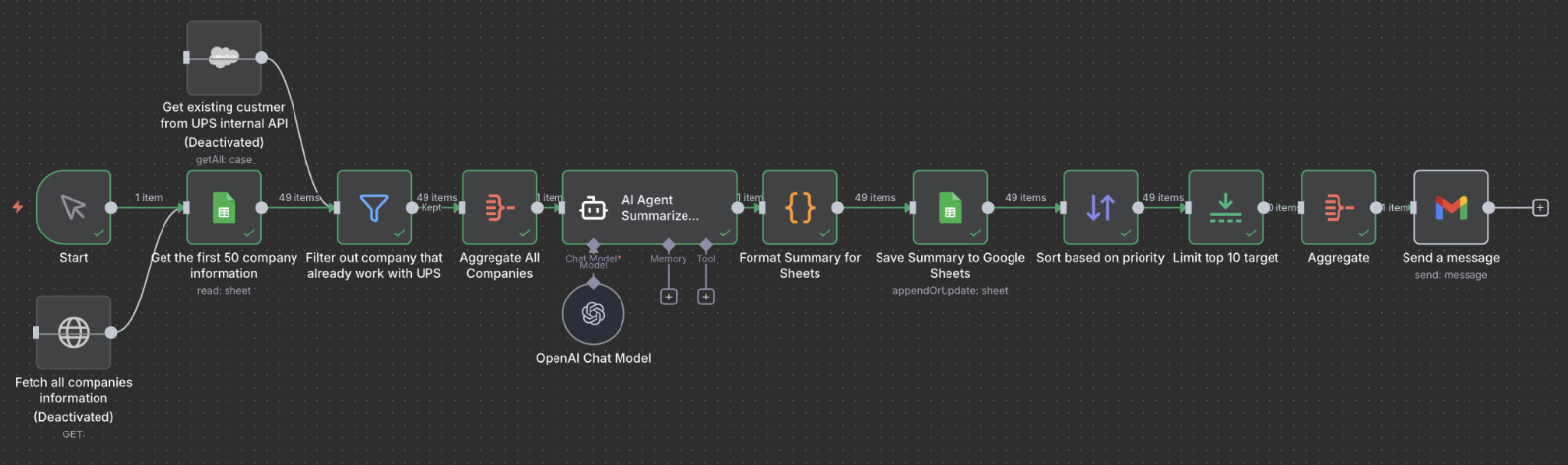
How the Workflow Works
-
Automation Trigger The workflow can run on a schedule (daily, weekly, or monthly) or be triggered manually.
-
Data Collection Company data is fetched from a public dataset (for the PoC, a sample of 50 companies was used).
-
Data Storage The collected data is stored in a lightweight database (Google Sheets for simplicity).
-
Existing Customer Filtering Companies that are already UPS customers are filtered out via a (theoretical) Salesforce API integration.
-
AI-Driven Analysis Each remaining company is analyzed by an AI reasoning model, generating:
- Company overview
- Potential UPS services
- Business scale and geographic reach
- A priority score from 1–10
-
Result Aggregation Companies are ranked by priority score, with the top prospects selected.
-
Automated Reporting A summarized report of the top leads is automatically emailed to sales teams .
Results: Scalable, Effective, and Surprisingly Cheap
The PoC successfully demonstrated that this approach is both technically feasible and operationally practical.
One especially interesting result was cost: even when using one of the most expensive AI APIs available, processing roughly 300 company records across multiple runs cost less than $0.01 USD.
This highlights a key insight: AI-powered automation doesn’t require heavy infrastructure or in-house model development to deliver real business value .
Why This Matters
This project reinforced a few important lessons for me:
- AI delivers the most value when embedded directly into workflows
- Automation is as much about consistency as it is about speed
- Lightweight tools can still support enterprise-scale use cases
- Hackathon ideas can — and should — evolve into real prototypes
The PoC shows strong potential for integration into UPS’s customer acquisition process, improving productivity, decision-making, and scalability without major operational disruption.
Final Thoughts
What started as a hackathon challenge turned into a concrete demonstration of how AI + automation can solve real-world business problems. I’m excited about the possibilities this approach unlocks — not just for UPS, but for sales-driven organizations facing similar challenges.
If you’re interested in AI-driven workflows, automation, or turning ideas into working systems, I’d love to connect and exchange thoughts.