

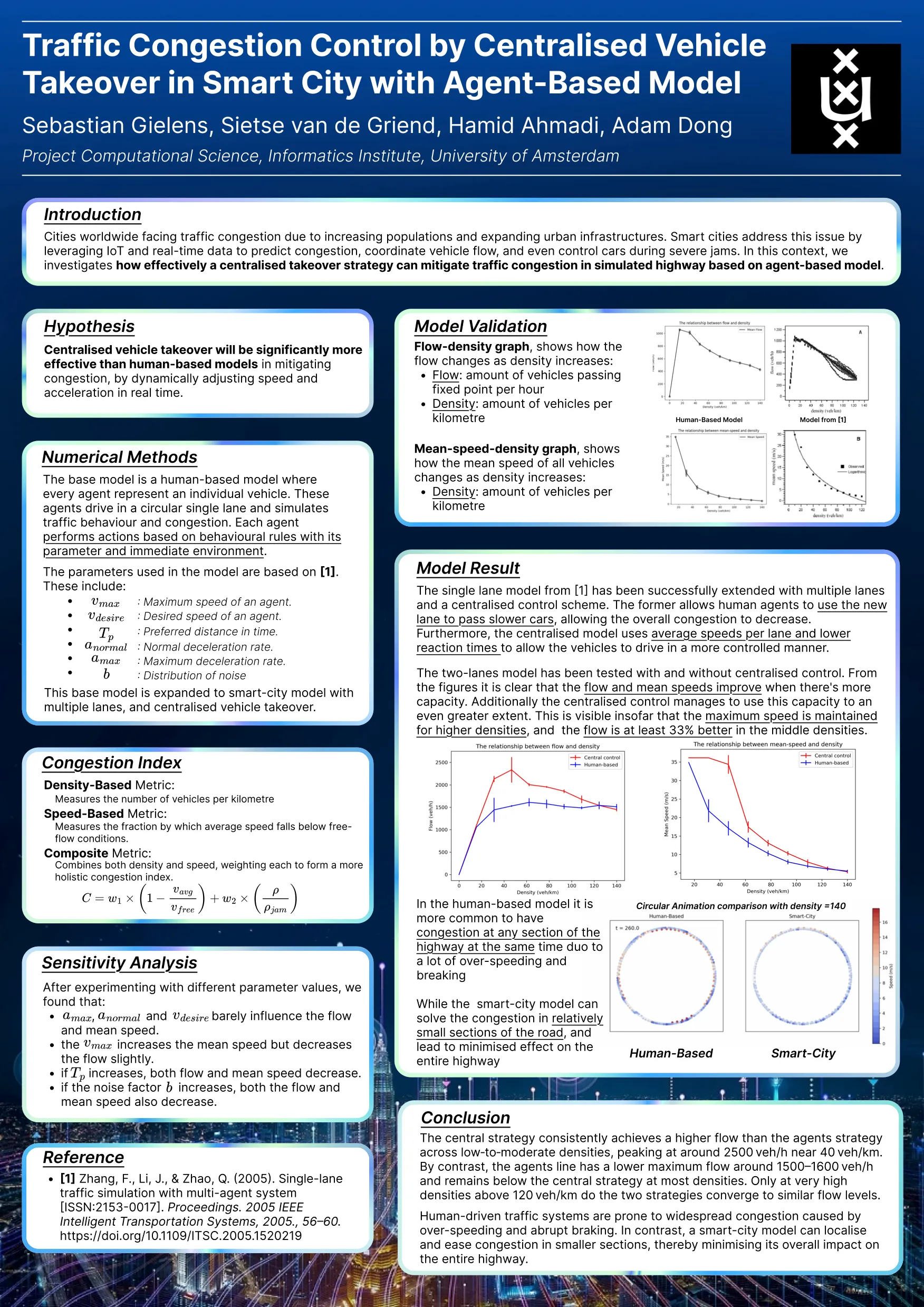
This project tried to investigate how effectively a centralised takeover strategy can mitigate traffic congestion in simulated highway based on agent-based model. This was done through the reproduction of an already existent agent-based model based on a paper by 1. The model was expanded upon by adding agent behaviour for multiple lanes and logic that simulates a central controller. It was hypothesized that centralized vehicle takeover will be significantly more effective than human-based models in mitigating congestion. This was confirmed as the central vehicle takeover managed to increase the average speed of the vehicles and maintain a higher flow under congested conditions.
Enhanced highway traffic throughput by 67% in simulation by implementing and evaluating centralized vehicle-takeover strategies. Flow improvement from ~1500 veh/h to ~2500 veh/h
My Role
- Developed dynamic data visualization and delivered a research poster and elevator pitch with excellent structure and quality, resulting a grade of 9/10.
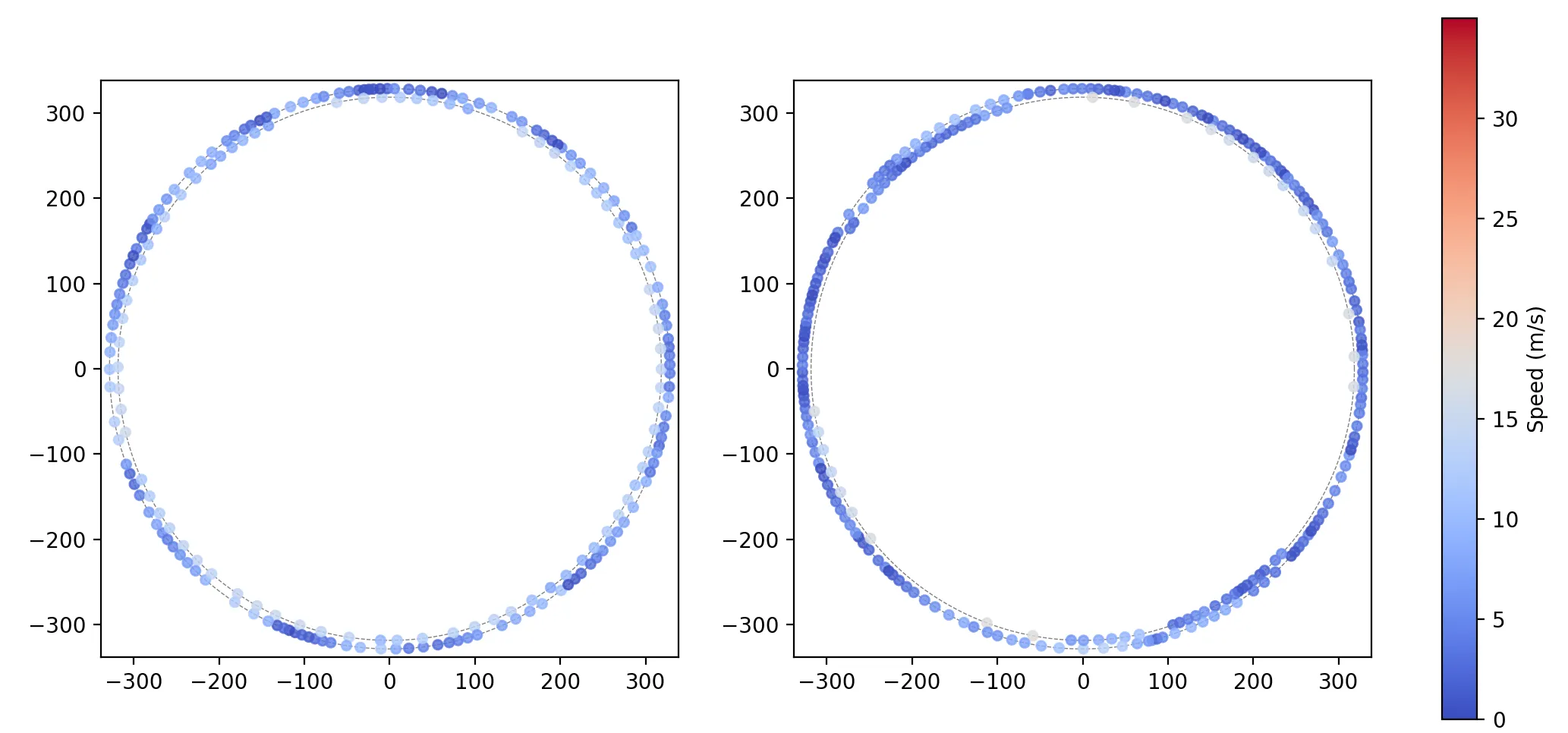
Visualization
Poster
Report and Poster Link
- Final Report: PCS_report.pdf
- Final Poster: Poster.pdf
Footnotes
-
Zhang, Fa, Jinling Li, and Qiaoxia Zhao (2005). “Single-lane traffic simulation with multi-agent system”. In: Proceedings. 2005 IEEE Intelligent Transportation Systems, 2005. IEEE, pp. 56–60. ↩